YouTube Shorts ideas, built on what YouTube itself recommends
Twenty-five ideas for Shorts, each opening the way YouTube’s April 2025 advice suggests: a question, a surprising fact, a striking first frame, a preview of a longer video, or one pointer. Each has a first line, a searchable working title and a note on whether it needs your face.
What to make YouTube Shorts about, by YouTube’s own advice
YouTube Shorts ideas built on YouTube’s own advice start from a question, a surprising fact or a visually captivating moment, the first of four tips in a YouTube blog post that Social Media Today reported on 17 April 2025. The other three: make a long video’s key hook the focus, let each Short preview the longer video, and give one actionable pointer per Short.
The 25 ideas below sit in five groups of five, one per opening, across cooking, DIY, gaming, study, fitness, money and tech, and 18 of them need no face. Each can run up to 3 minutes. Because every play has counted as a view since 31 March 2025, compare ideas on engaged views and average view duration.
★★★★★4.7 out of 5 from 325 ratings on the App Store · iPhone and iPad app by Monadly
Four tips from YouTube make five ways to open a Short
YouTube’s first tip names three openings, a question, a surprising fact or a visually captivating moment, and each is a group here. The key hook and preview tips form the fourth group. One actionable pointer is the fifth.
Start from what you have. Shorts ideas for a channel with long videos already sit in its back catalogue, so begin with the preview group. A beginner can start with the single pointer: one instruction, one take. A TikTok-first account can use the 30 TikTok video ideas, grouped by camera setup instead of by opening.
25 Shorts ideas, each with a first line and a working title
Each idea gives the niche, the line said or shown at 0:00, and a working title built on a phrase people search for. “No face” means hands, a screen, gameplay or a body framed from the neck down. Swap the nouns.
The question
The first words on screen are a question the viewer has already typed into YouTube search.
Cooking (no face): “Why is your rice sticky when the packet says fluffy?” Title: Fluffy rice on the stove: the rinse test.
Gaming (no face): “Spend your first gold now, or save it for the second map?” Title: Beginner build guide: spend or save gold.
Fitness (no face): “Should your elbows flare out when you do a push-up?” Title: Push-up form for beginners, elbows tucked.
Money: “Pay off the smallest debt first, or the highest rate?” Title: Debt snowball vs avalanche, explained.
Study: “Is a 25-minute study block too short?” Title: How long to study before taking a break.
The surprising fact
A test you ran on camera makes the fact checkable at 0:00.
Cooking (no face): “My oven dial says 180°C. The thermometer on the rack disagrees.” Title: Oven temperature test with a cheap thermometer.
DIY (no face): “Two drills, one box of screws: the cheaper one finished first.” Title: Cheap vs expensive drill test.
Tech (no face): “This fast charger filled my phone slower than the old one.” Title: Fast charger test: watts vs real charge time.
Fitness (no face): “Ten minutes of stairs pushed my heart rate higher than my 20-minute jog.” Title: Stair climbing vs jogging: heart rate test.
Money: “Last year my bank fees cost more than my phone bill.” Title: How to find hidden bank fees on a statement.
The visual moment
Frame one does the work, so the line stays under eight words.
Cooking (no face): “Sugar, water, heat. Now tap it.” Title: How to make caramel shards at home.
DIY (no face): “Half this patio is ten years dirty.” Title: Pressure washing a patio: before and after.
Gaming (no face): “Three rooftops, one jump, no checkpoint.” Title: Rooftop speedrun route with no checkpoint.
Tech (no face): “This is inside a stick-drifting controller.” Title: Controller stick drift: what’s inside the stick.
Study (no face): “Every exam topic on one wall.” Title: Exam revision wall: a whole study plan in sticky notes.
The preview
Each line is a long video’s key hook, and the last 3 seconds name the full video.
Tech (no face): “Brightness drained this battery faster than any other setting I tested.” Title: Laptop battery test: which setting drains it fastest.
Cooking (no face): “This is the moment the dough is ready to bake.” Title: Bread dough poke test: when it’s proofed.
Gaming (no face): “Watch the shield drop after the third swing.” Title: How to beat the bridge boss: shield timing.
DIY (no face): “One pull of the saw and the old grout lifts out whole.” Title: How to remove old grout without cracking tiles.
Money (no face): “Ninety days of receipts, and one supermarket took a fifth of the total.” Title: Tracking every receipt for 90 days: what it showed.
The single pointer
One instruction to carry out today. The 45-second worked example below plans the first.
Tech (no face): “Before you unplug, drop the brightness to half.” Title: How to make a laptop battery last longer.
Fitness: “Squeeze the bar like you’re trying to bend it.” Title: Bench press grip tip for beginners.
Study: “Close the book and write down everything you remember.” Title: Active recall study method in one step.
Cooking: “Salt the pasta water until it tastes like a mild broth.” Title: How much salt to put in pasta water.
Money: “Turn off auto-renew the day you subscribe.” Title: How to stop paying for forgotten subscriptions.
One 18-minute video holds three Shorts
An 18-minute laptop battery test, one laptop run flat under different settings, holds at least three Shorts, each following a different YouTube tip. Each opens differently.
The laptop battery test from the table on this page. Three passages of 40 to 45 seconds become three Shorts, each opening a different way, and each ends on a card naming the full test, so every Short is also a preview of the long video.
Three Shorts cut from one 18-minute laptop battery test
Short
Source timestamp
Opening line
YouTube tip it follows
1. The question (40 s)
3:10–3:50
“Does battery saver do anything on a laptop?”
Open with a question
2. The reveal (45 s)
12:20–13:05
“Brightness drained this battery faster than any other setting I tested.”
Make the long video’s key hook the focus
3. The pointer (45 s)
15:30–16:15
“Before you unplug, drop the brightness to half.”
One actionable pointer per Short
All three end on a card naming the full 18-minute test, so each is also a preview, the remaining tip. The pre-upload checklist for Shorts covers the cut itself and the checks to run on the exported file.
How long should a Short from this list run?
Run each Short as long as its one idea takes, within the 3-minute cap YouTube sets for Shorts. In the table, the question needs 40 seconds and the pointer 45.
The view count cannot rank two ideas. From 31 March 2025, every start and every replay of a Short adds a view, however briefly it plays. Loops inflate it. Compare engaged views, which count viewers who chose to keep watching, and average view duration, which YouTube calculates from engaged views and their watch time. The guide to Shorts with low views reads both in YouTube Studio.
A 45-second single-pointer Short holds about 112 words
At about 2.5 spoken words a second, this site’s rule of thumb, a 45-second Short holds 45 × 2.5 = 112.5, so about 112 words of script. Take the first single-pointer idea, the third Short in the battery table. One pointer means one claim, one demonstration and one result.
Claim, 0:00 to 0:05. 5 × 2.5 = 12.5, so about 12 words: “Before you unplug, drop the brightness to half. Watch both graphs.”
Demonstration, 0:05 to 0:35. 30 × 2.5 = 75 words over the slider dropping to 50% and both runs’ battery graphs.
Result, 0:35 to 0:45. 10 × 2.5 = 25 words on the final readings and the card naming the full test.
Check the sum: 12.5 + 75 + 25 = 112.5. Battery saver and streaming stay in the 18-minute video. Write to the budget.
Go Viral scripts a kept idea in 15–60s beats and scores its first 3 seconds
The Idea Generator in Go Viral suggests trend-aligned content ideas for the niche and audience you type in. File each under one of the five openings above; an idea that fits none needs an opening first.
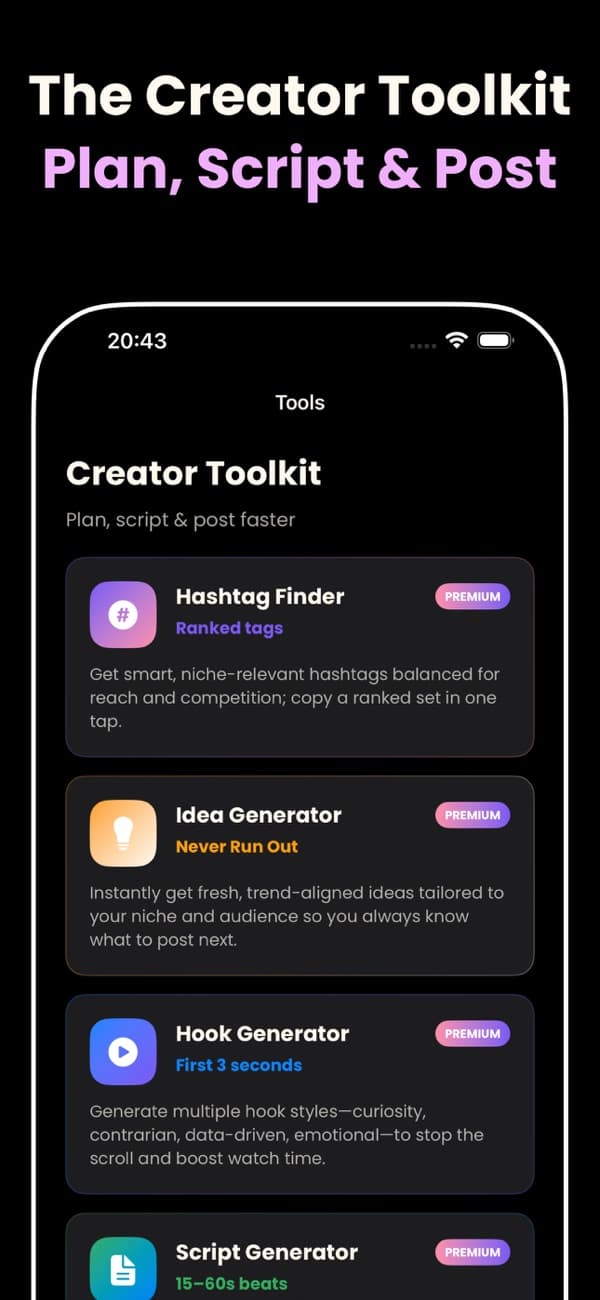
From the appOn the Creator Toolkit screen, the Idea Generator card reads “Never Run Out” and the Script Generator card reads “15–60s beats”.
The Script Generator turns a kept idea into a short-form script ready to record, laid out in 15–60s beats. The Script Generator page has beat sheets at 15, 30 and 60 seconds, so the 45-second pointer sits between the last two.
After the cut, import the clip or paste the Shorts link. The Hook Score puts a number from 0 to 100 on the first 3 seconds, and the Hook Score page explains the scale. Channel data stays with YouTube.
Questions about Shorts ideas
What should I make YouTube Shorts about?
▼
Make each Short about one thing a viewer wants: an answer, a fact they did not expect, a moment worth watching, a long video’s key hook, or one tip. Those five openings come from YouTube’s April 2025 advice on Shorts. Pick the one your footage already holds.
Can I make YouTube Shorts without showing my face?
▼
Yes. 18 of the 25 ideas on this page need no face: they use hands, a screen recording, gameplay or a body framed from the neck down. Put the opening line on screen as text, or say it as a voiceover at 0:00.
Can I turn my long videos into Shorts?
▼
Yes, and YouTube’s four tips are written for that job: make each long video’s key hook the focus of a Short, and treat the Short as a preview. The 18-minute battery test on this page yields three Shorts: a question, a reveal and a pointer.
How long should a YouTube Short be?
▼
Long enough for its one idea, within YouTube’s 3-minute cap for Shorts. The single-pointer example here runs 45 seconds, about 112 spoken words at this site’s rule of thumb of 2.5 words a second. Since 31 March 2025 every play counts as a view, so compare two lengths on engaged views.
From one idea to a scored first 3 seconds
Ideas for your niche and audience, a script in 15–60s beats, and a Hook Score for the first 3 seconds of the cut. Go Viral is free to download for iPhone and iPad, and all features need a subscription.