TikTok hooks for products: 30 openings by what the first frame shows
Thirty opening lines for product and TikTok Shop videos, sorted into six kinds of first frame. Then a garlic press opening rewritten three ways, where to study ads that already work, and the claims to keep out of a hook.
By the Go Viral team at Monadly · Updated · First published · Editorial policy
What a product hook has to do in 2 seconds
TikTok hooks for products need the product, or the problem it fixes, on screen within the first 2 seconds, with on-screen text that works with the sound off. “Hey guys, I got this new garlic press” over a face fails that test. “10 cloves, 40 seconds” beside a phone timer passes it.
The page’s 30 lines sort into six first frames: the problem, the result, the product mid-use, a number, an answered objection, and a side-by-side with what the viewer owns. They cover clothing, skincare, kitchen gadgets, phone accessories, home and cleaning, and pets. Leave out any claim the footage cannot show. Paid partnerships go through TikTok’s content disclosure setting.
★★★★★4.7 out of 5 from 325 ratings on the App Store · iPhone and iPad app by Monadly
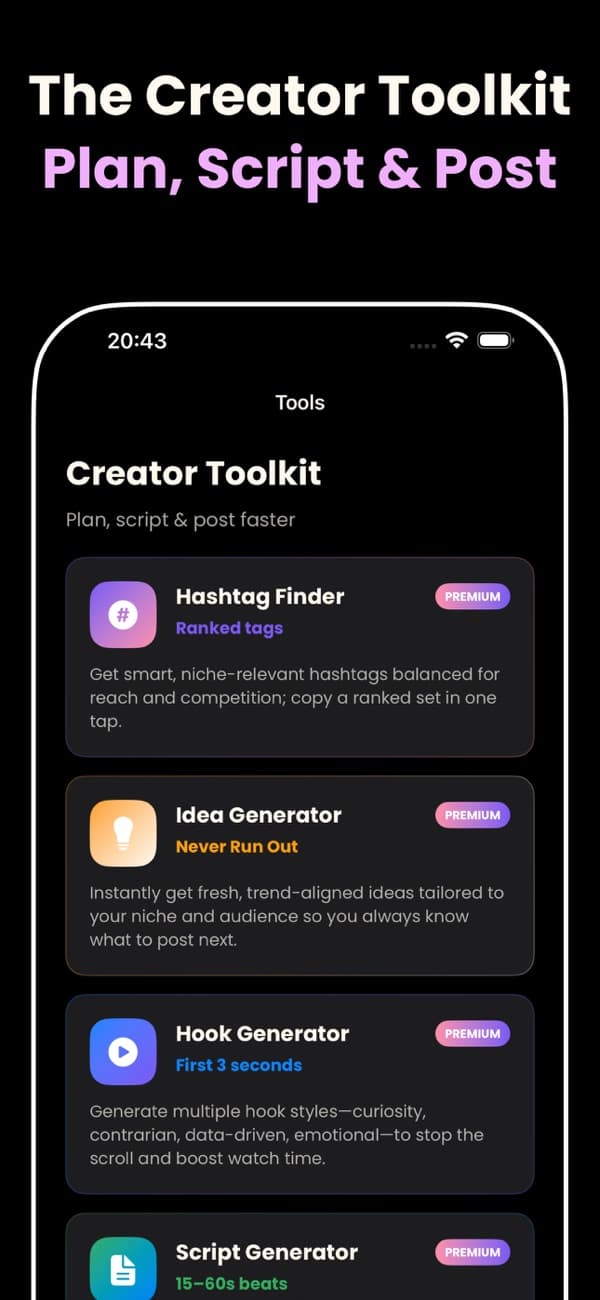
From the appThe Hook Generator in the app’s Creator Toolkit is labelled “First 3 seconds” and writes several hook styles: curiosity, contrarian, data-driven and emotional. For a product, describe what the first frame shows and pick the style that matches it.
Each of these 30 product video hooks starts from the first frame
Each group starts from what the viewer sees at 0:00, and each line works as on-screen text and as the spoken sentence. Keep the frame. Swap the product.
The problem
Use it when: The viewer lives with the stain, the tangle or the mess and knows it in under 1 second.
Home and cleaning. This coffee stain has been on my rug for three months.
Phone accessory. Every charging cable I own ends up looking like this.
Pet. One week with a husky, and this is my sofa.
Clothing. Jeans that gape at the waist every time I sit down.
Kitchen gadget. This jar lid has beaten me three nights in a row.
The result first
Use it when: The after is the reason to buy and reads as a still frame at 0:00.
Clothing. This whole outfit is one pair of trousers and things I already owned.
Home and cleaning. Same oven door, ten minutes and one paste later.
Skincare. This is my foundation at 6 p.m. with this primer under it.
Phone accessory. Phone, watch and earbuds, all charging from this one stand.
Pet. First nail trim where my dog sat still the whole time.
The product mid-use
Use it when: The motion explains the product in 1 second, so the hands are already using it.
Kitchen gadget. Watch the yolk slide out without touching the white.
Clothing. Pull this tab and the whole jacket folds into its own pocket.
Phone accessory. Snap it on and the phone stands up by itself.
Home and cleaning. One pass of this squeegee and the shower glass is done.
Pet. Peanut butter on this mat, and he stays in the bath for the whole wash.
The number
Use it when: The product has one checkable figure (price, minutes, grams, count) that you measured yourself.
Kitchen gadget. Six egg bites from this silicone mould, and the oven timer says 18 minutes.
Clothing. These trousers have six pockets, and my phone fits in every one.
Skincare. One 50 ml tube lasted me nine weeks of mornings.
Phone accessory. This power bank weighs 110 grams. My phone weighs more.
Pet. A $12 scratcher my cat has used every day since June.
The objection
Use it when: Comments on similar videos repeat one doubt, and you can answer it in one shot.
Clothing. If you are 5 foot 2, this is what the maxi length does.
Skincare. “It pills under makeup.” Here it is under foundation at hour eight.
Kitchen gadget. “Another gadget for the drawer.” It is the size of a spoon and goes in the dishwasher.
Home and cleaning. Everyone says cordless vacuums are weak. Watch the rug.
Pet. “My dog will shred it in a day.” This is day 40.
The comparison
Use it when: The viewer owns the older version, and both fit in one frame under the same light.
Phone accessory. My old cable on the left, this braided one on the right, both after a year in a bag.
Home and cleaning. Kitchen roll on the left, this cloth on the right, same spill.
Skincare. Left, my old sunscreen. Right, this one. Same light, no white cast.
Kitchen gadget. Your peeler against this one, same carrot, ten seconds each.
Clothing. Two pairs of black leggings, same squat, same window light.
The six clothing lines also work as hooks for a clothing brand, since each opens on the garment, never on the person describing it.
Product hooks have to show the product by second 2
A product hook has to put the product in front of the viewer within the first 2 seconds. A creator hook can open on a face, because the audience came for the person. A product video is there for the thing: the press, the cable, the stain.
The rule from this page drawn on the clock: an audience follows a creator for the person, but a product video is there for the thing, so the press, the cable or the stain is in frame before second 2. Watch it muted; if a stranger could not name the product, reshoot the first frame.
The second difference is sound. Write the on-screen text first, because it carries the hook for anyone scrolling with the volume down. Mute the phone and watch your first 2 seconds; if a stranger could not name the product, reshoot the first frame. TikTok lists watching in full or skipping among its For You signals. A muted greeting hands the viewer two seconds in which to skip.
The weak version opens on “Hey guys, I got this new garlic press,” over a face. The press enters after the sentence ends, and nothing on screen tells a muted viewer what the video sells.
The problem. Text: “Ten cloves did this to my hands.” The first frame shows sticky fingers over garlic skins, with the press coming in from the side at second 1.
The product mid-use. Text: “Unpeeled clove in. One squeeze.” The first frame shows a hand closing the press with garlic already pushing through the holes.
The number. Text: “10 cloves, 40 seconds.” The first frame shows a phone timer at 0:00 beside the press and ten cloves.
The number has to come from your press. Time one clove: at 4 seconds a clove, ten take 10 × 4 = 40 seconds. At 6 seconds a clove, ten take 10 × 6 = 60, and the line becomes “10 cloves, one minute.”
Record all three. Each puts the press in frame before second 2, which the original never did.
How to find product hooks that already work in your category
TikTok’s Creative Center has a public Top Ads library that shows top-performing ads by region and industry, and its first frames are a working reference for product hooks.
Open Top Ads and set your region and the industry closest to the product.
Pick ten ads in your category and watch only the first 2 seconds of each.
Write down what each first frame shows, such as “hand pouring cleaner on a stained rug”.
Sort the ten notes into the six groups above. Count them.
If six of the ten open on the product mid-use, record that group first. The library shows ads, not organic posts, so it tells you what advertisers open with and nothing about how an unpaid post travels.
Your own posts fill that gap. TikTok analytics can take 1 to 2 days to update. After that, the engagement rate calculator divides each video’s likes, comments, shares and saves by its views, so two product openings compare on one scale.
Which claims should stay out of a product hook?
A hook that promises a medical, weight-loss or income result makes a claim 2 seconds of footage cannot show. Cut it.
Claims to keep out of a product hook and what to say instead
Keep out of the hook
Say instead
Why
“Cures acne”
“Gel texture, no fragrance, dries in under a minute,” if the clip shows it
A medical result a short clip cannot show
“You will make money with this”
What the buyer gets: “12 video lessons and a budget template”
An income result depends on the buyer, and no clip can show it
“Lose weight without trying”
What the product does: “holds 1 litre and fits a cup holder”
A weight-loss result no clip can show
“Kills every germ”
The wording printed on the label, word for word
A lab claim you cannot check at home
#ad hidden among ten hashtags
Switch on the content disclosure setting
TikTok’s branded content policy requires paid partnerships to be disclosed with that setting
“Only 3 left”
The stock you can see on the day, or nothing
Urgency that is false when someone watches
How Go Viral fits a product video
The Hook Generator in Go Viral writes several hook variations from a one-line product description. The Hook Score then rates each recorded take from 0 to 100 on its first 3 seconds.
Describe the product in one line, such as “stainless garlic press that takes unpeeled cloves”.
From the openings the hook generator returns, keep two or three that fit different first-frame groups above.
Record each with the product in frame by second 2 and the text on screen from frame one.
Import the takes, compare their hook scores and post the highest-scoring take.
For everything after the opening, the script generator turns the product topic into a ready-to-record short-form script.
Record first, then score. The app runs on iPhone and iPad and reads the clip you import; it does not connect to your TikTok account.
Product hook questions
What is a good hook for a product video?
▼
A good hook for a product video puts the product, or the problem it fixes, on screen inside the first 2 seconds, with on-screen text that works muted. Pick one of the six first frames above and make one promise the footage can show.
How do you start a TikTok Shop video?
▼
Start on the product already in use, with the hook as on-screen text from the first frame. Skip the greeting and the unboxing. Say what the product does in the first sentence and show it doing that by second 2.
What are UGC hooks?
▼
UGC hooks are the opening lines of user-generated-content videos, where a creator films a brand’s product the way a customer would, on a phone, at home. They use the same six first frames. The line sounds like one person’s opinion: “this is the cable that survived my bag.”
Do I have to disclose paid product videos on TikTok?
▼
Yes, for paid partnerships. TikTok’s branded content policy requires paid partnerships to be disclosed with the content disclosure setting. A #ad tucked among ten hashtags does not replace that setting. Read the policy page before the first paid post.
One line about the product, several openings back
Describe the product in one line, record two openings from different first-frame groups, and compare the Hook Score of each take.